

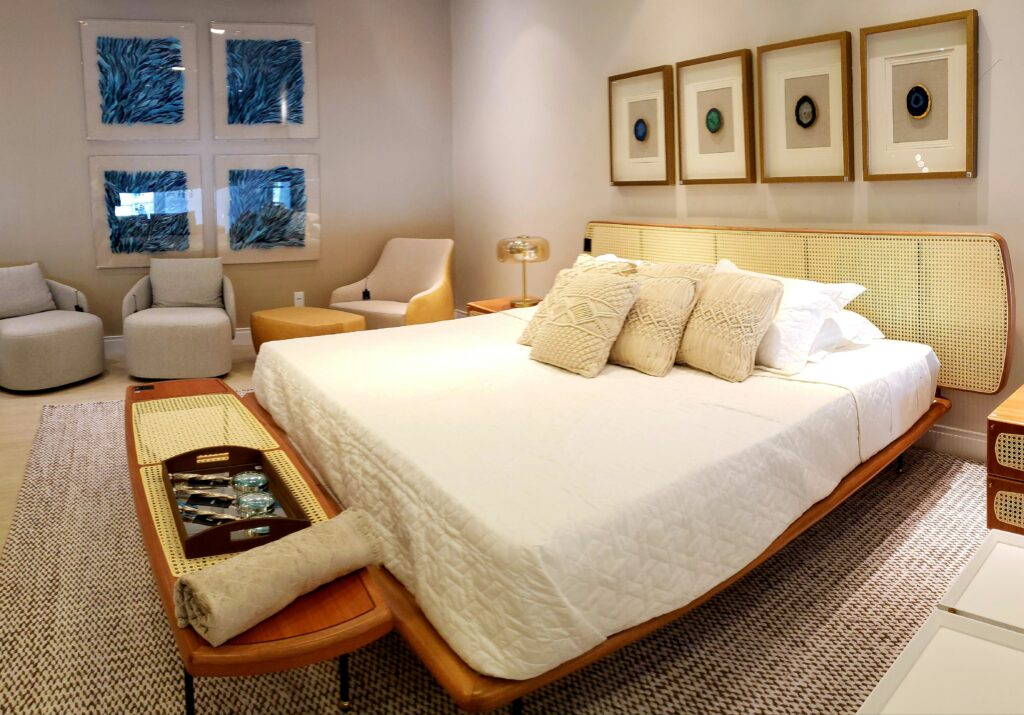
If you have been searching for a 6×6 bed frame in Nigeria recently, you already know the market does not give you a straight answer. Prices range from ₦120,000 at the low end to well above ₦3,000,000 at the top, and without a clear guide, it is easy to either overspend on something that does not justify its price, or underspend on something that warps, peels, or falls apart within two years.
This guide breaks down exactly what 6×6 bed frame prices look like in Nigeria in 2026, what separates cheap from genuinely good value, and what you should realistically budget for a bed frame that serves your bedroom well over time.
What Is a 6×6 Bed Frame?
A 6×6 bed frame measures six feet by six feet, which is the standard Nigerian king size. It is the default specification for a master bedroom in mid-to-luxury Nigerian homes, and the size most furniture buyers encounter when building, renovating, or upgrading a primary bedroom. If you are furnishing a guest room or a child’s room, a 4×6 or 4.5×6 frame may apply. But for a master bedroom, 6×7 is the benchmark.
6×6 Bed Frame Prices in Nigeria: The Market in 2026
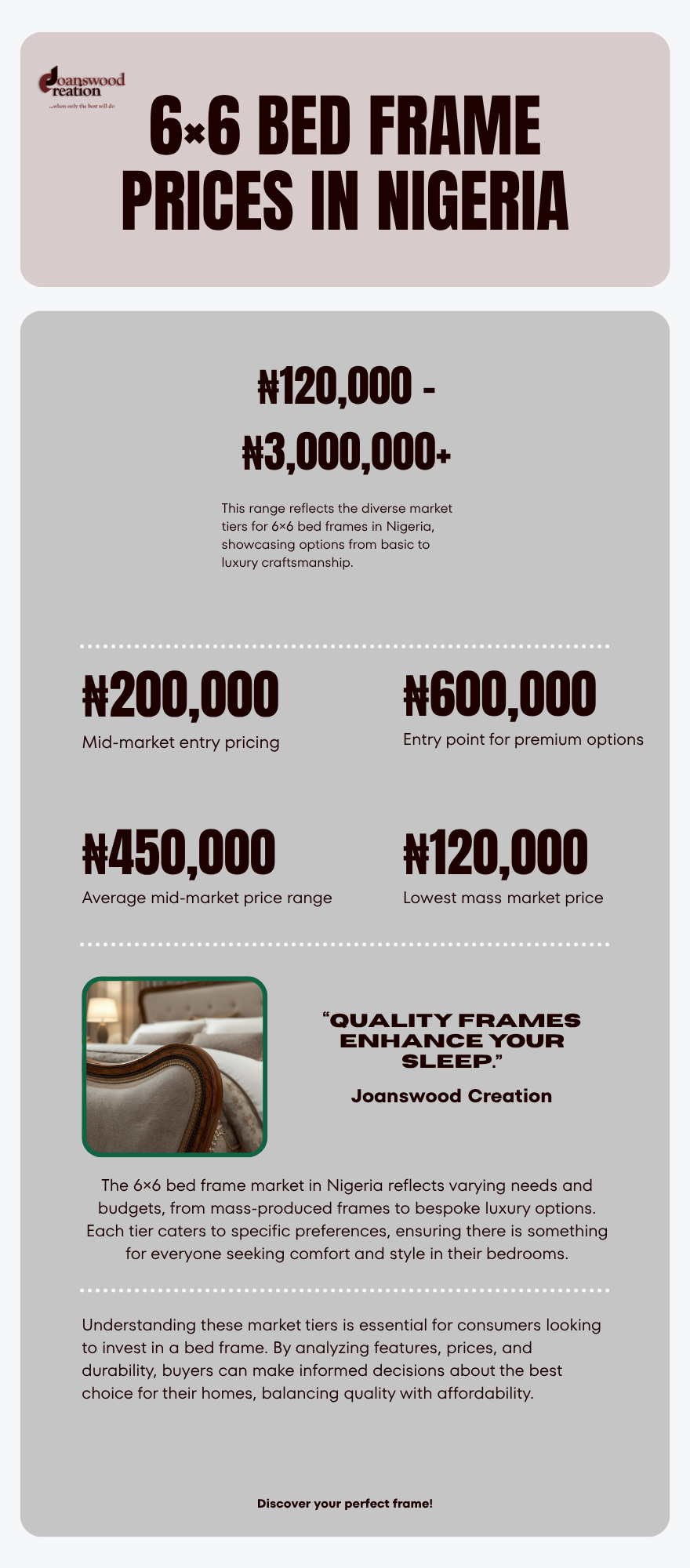
The Nigerian furniture market has settled into three clearly defined pricing tiers. Understanding where these tiers begin and end, and what quality each one actually delivers, is the most useful thing you can know before making a purchase.
| Tier | Price Range | What You Are Buying |
|---|---|---|
| Mass Market | ₦120,000 – ₦280,000 | Basic frames from local informal workshops |
| Mid-Market | ₦200,000 – ₦450,000 | Structured contemporary brands, standard designs |
| Premium & Luxury | ₦761,800 – ₦3,000,000+ | Bespoke construction, ISO-grade materials, full installation |
Joanswood Creation deliberately bridges the upper-mid and premium tiers, with entry-level premium pieces starting from ₦600,000. This makes bespoke craftsmanship accessible below the general market’s premium floor. See the Joanswood range breakdown below.
The picture below represents the full spread of the market. Now here is what each tier actually means.
The Three Tiers of the Nigerian Bed Frame Market
Mass Market: ₦120,000 – ₦280,000
At this price point, you are typically buying from informal carpentry clusters, with local workshop towns along the Ikorodu corridor being a primary source. Materials are untreated softwoods or basic plywood with minimal finishing. Upholstery, where it exists, uses low-grade polyester or polyurethane leather over low-density foam.
The concern here is not merely aesthetic. In Lagos and other coastal cities, the humidity level is consistently high. Timber that has not been properly kiln-dried will absorb moisture, swell at the joints, and shift dimensionally over time. Most buyers in this tier are back in the market within eighteen to twenty-four months, which means the apparent savings are not real savings at all.
Mass-market frames are reasonable for short-term rental properties, children’s rooms with anticipated upgrades, or truly temporary living arrangements. For a master bedroom you plan to live in, the risk is not worth taking.
Mid-Market: ₦200,000 – ₦450,000
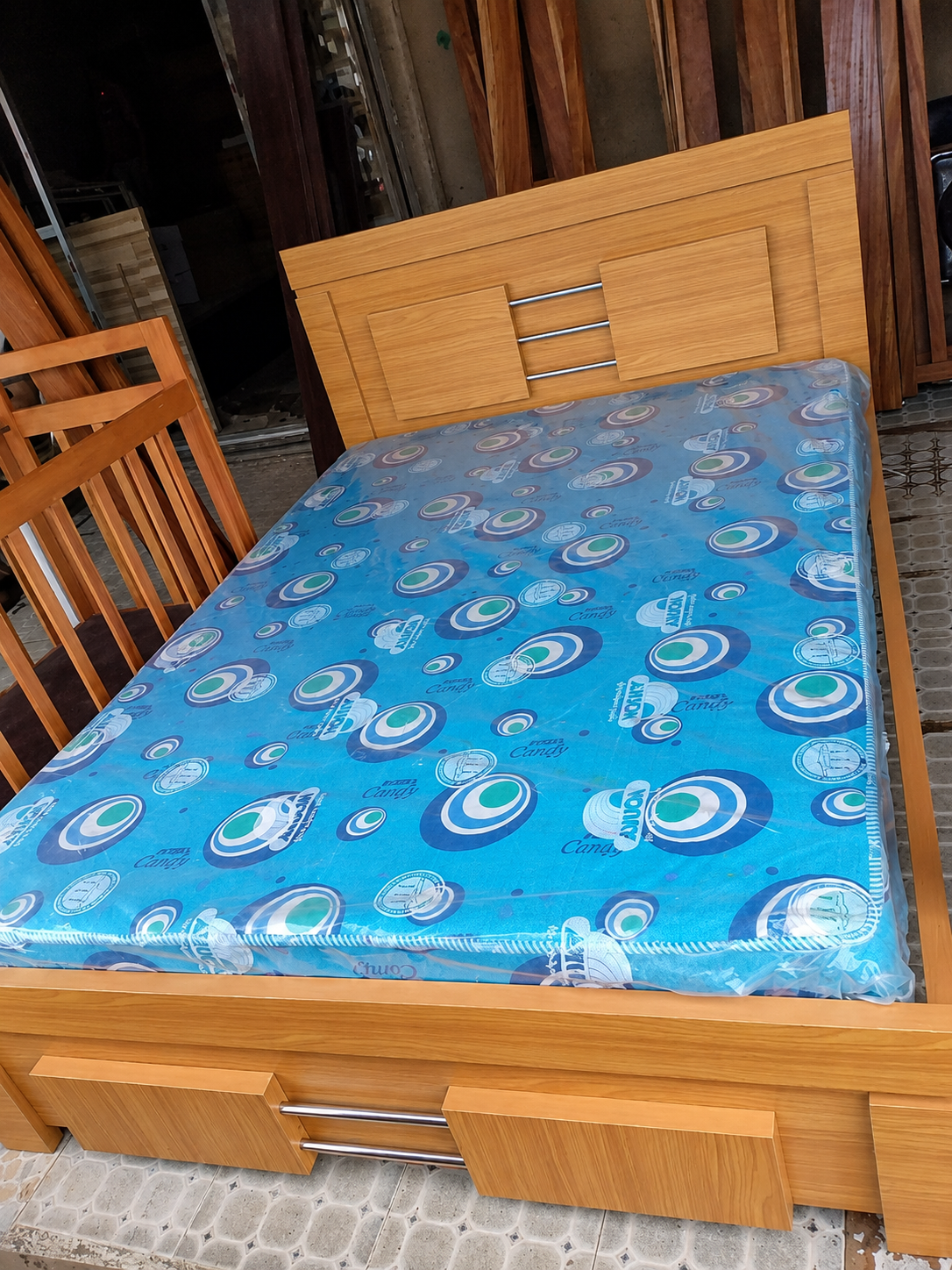
This segment is anchored by established contemporary brands that deliver more predictable quality than informal workshops. Brands like Taeillo and Vava Furniture operate here, using engineered wood such as MDF, MFC (Melamine-Faced Chipboard), and chipboard with laminate finishes, supported by powder-coated metal legs and frames.
The aesthetics are typically Scandinavian-influenced with modern, clean lines. Practical features like detachable headboards, integrated storage drawers, and nationwide flat-pack delivery make these brands attractive to upwardly mobile professionals and suburban families.
The trade-off is standardization. You are selecting from a catalogue of fixed designs rather than commissioning something for your space. If your bedroom is a distinct, well-considered room, a generic product will often feel slightly off, proportionally or stylistically.
Premium and Luxury: ₦761,800 – ₦3,000,000+
This is where custom furniture brands like Joanswood Creation operate. At this level, the conversation shifts from which bed frame you can afford to which one is actually right for your bedroom.
Materials are European ISO-certified MDF and MFCF boards, engineered to resist peeling, warping, and moisture, which are critical performance requirements in Nigeria’s humid coastal climate. Upholstery uses high-wear Turkish velvet, top-grain leather, or premium linen. Internal structural supports are heavy-duty steel brackets, not wood dowels. And the design process itself is a service: Joanswood Creation uses 3D CAD modelling to show you exactly how a custom bed frame, wall panel, and integrated storage will look in your specific room before a single plank is cut.
While the general premium market floor sits around ₦761,800, Joanswood has deliberately engineered an entry point at ₦300,000, bridging the upper end of the mid-market with full premium construction standards. The philosophy behind this is straightforward: bespoke quality and structural integrity should not require a near-₦1000,000 opening commitment.
The range extends to ₦3,000,000. For context, fully imported European and Italian bedroom configurations can climb to ₦15,000,000 or beyond at the extreme end of the market, but Joanswood delivers equivalent material integrity and bespoke design intent entirely within a locally manufactured framework, at a fraction of that cost. The most ambitious single Joanswood Creation 6×6 project completed to date reached ₦1,600,000, a figure that reflects design complexity, premium material sourcing, and the level of craftsmanship invested in bringing that particular vision to life.
What Actually Drives 6×6 Bed Frame Prices in Nigeria?
The price variation across the market is not arbitrary. Several structural forces determine what you pay.
Material Quality and Origin
This is the single biggest cost driver. Locally sourced hardwood species, such as Itara, Ori, and Akun, are the most affordable structural options, with planks ranging from ₦1,648 to ₦11,050. But their performance depends entirely on proper kiln-drying, a process that is energy-intensive and frequently skipped by lower-tier workshops.
Premium engineered boards cost more because they perform more reliably. Standard MDF sheets retail at around ₦22,500 per sheet. Standard HDF runs to ₦39,000. High-gloss HDF, used for premium external panels and drawer fronts, retails at approximately ₦56,000 per sheet. These materials are dimensionally stable, moisture-resistant, and built for the long term.
Craftsmanship and Design Complexity
A frame priced at ₦800,000 and one priced at ₦200,000 may both be described as “wooden bed frames.” The difference lies in the joinery precision, grain matching, fabric channelling, hardware quality, and finish work. These details take time. And skilled furniture time in a well-run manufacturing facility costs what it costs.
As Joan at Joanswood puts it directly: the most expensive 6×6 projects carry their price because of the combination of design complexity, material selection, and the craftsmanship put into each piece. That is not a marketing phrase; it is a description of how the cost is actually structured.
Energy and Logistics Costs in 2026
This is a reality most buyers do not think about but every manufacturer in Nigeria feels acutely. Diesel (AGO) for industrial generators now runs above ₦2,474 per litre. Petrol averages ₦1,300 to ₦1,532 per litre. Every hour of workshop operation, every kiln-drying cycle, and every delivery journey carries those costs. They flow into the price of the furniture.
Delivery and Installation
This is where many buyers encounter unexpected costs. Standard courier rates only apply to parcels under 5kg. A flat-packed or assembled 6×6 bed frame exceeds 80kg. Within Lagos, professional heavy furniture delivery and installation runs from ₦25,000 to ₦65,000 depending on your delivery zone. Interstate shipping to Abuja, Port Harcourt, or Kano runs from ₦80,000 to over ₦180,000 per unit.
Joanswood offers free delivery within Lagos on orders above ₦2,000,000, which is a meaningful savings to factor into your total cost comparison at the premium end.
Import Tariffs and Exchange Rate Exposure
Nigeria’s official exchange rate currently sits at approximately ₦1,373 per US dollar. For manufacturers sourcing European fabrics, imported hardware, or engineered boards from China, where benchmark FOB prices run around $10.86 per piece, every fluctuation in the rate affects landed cost directly. The federal government’s 2026 Fiscal Policy Measures have added further Import Adjustment Taxes on 192 tariff lines, raising costs on imported steel hardware and structural components. Brands that manufacture locally rather than importing finished furniture navigate this more efficiently and pass less of that burden to the buyer.
Have 6×6 Bed Frame Prices Changed in Recent Years?
Yes, significantly.
Joan is direct about this: prices have risen over the past three years, driven by two forces working simultaneously. Inflation has raised the baseline cost of materials, energy, and logistics across the board. National headline inflation sat at approximately 15.69% in mid-2026, following fuel price increases of over 640% since 2023.
At the same time, customer expectations have grown. Nigerian buyers, particularly in the premium segment, are asking for more customization, better materials, and deeper integration between the bed frame and the overall bedroom design. More ambitious briefs require more time, more skilled labour, and more expensive raw materials. That shows in the final price.
The practical implication: a budget that felt generous two years ago may sit in a different tier of the market today. Factor this into your planning.
What Is the Minimum You Should Spend Without Regretting It?
Joan’s answer, from years of building and delivering furniture in Lagos, is ₦300,000.
Below that threshold, the compromises on materials or craftsmanship become significant enough that you are likely to encounter problems, such as warping, joint failure, or peeling laminate, before you have gotten full value from the piece. In a humid coastal city, this is not a hypothetical risk. It is a predictable outcome.
₦300,000 marks the floor of Joanswood’s range for a reason: it is the point where material quality, structural integrity, and design attention are sufficient to justify the investment in furniture you will actually keep.
Joanswood’s 6×6 Bed Frame Range: What You Get at Each Price Point
To make the price-to-value relationship concrete, here is how it maps across Joanswood’s current offering.
₦400,000 to ₦600,000: Entry-Level Premium. Solid construction using quality engineered boards or premium timber with a clean, refined finish. No structural shortcuts. Designs at this level prioritise lasting build quality and clean aesthetics without elaborate customization.
A benchmark example: the Hermoso Bed at ₦452,400, which features engineered wood and fabric construction with two integrated storage drawers, designed for a functional and well-finished master bedroom.
₦600,000 to ₦900,000: Mid-Range Premium. Greater design detail, higher-grade fabric or timber selection, and more structural complexity. The Mara Frame (₦730,080), Upholstered Frame (₦761,800), Modern Tufted Bed (₦780,780), and Buru Bed Frame (₦819,000) each occupy this range. Each is distinct in design, from deep vertical fabric channelling to natural premium grain, and consistent in quality of execution.
₦900,000 to ₦2,000,000+: Full Bespoke. At this level, you are commissioning a piece, not selecting from a catalogue. The Maka Bed Frame at ₦1,109,823 uses hand-selected luxury timber with premium grain matching across every panel. Full bedroom sets, including the bed frame, integrated wall panelling, and matched bedside tables, bring total spend to ₦2,000,000 and above. Joanswood’s most ambitious completed 6×6 project came in at ₦1,600,000.